
Your child attends Quran classes at the local mosque twice a week. They enjoy seeing their friends, but you’re not sure how much reading practice they’re getting.
Meanwhile, another parent has chosen one-to-one online lessons. There’s no travelling after school, but their child misses learning alongside other children.
Both families want the same thing: meaningful Quran learning that fits their child’s needs.
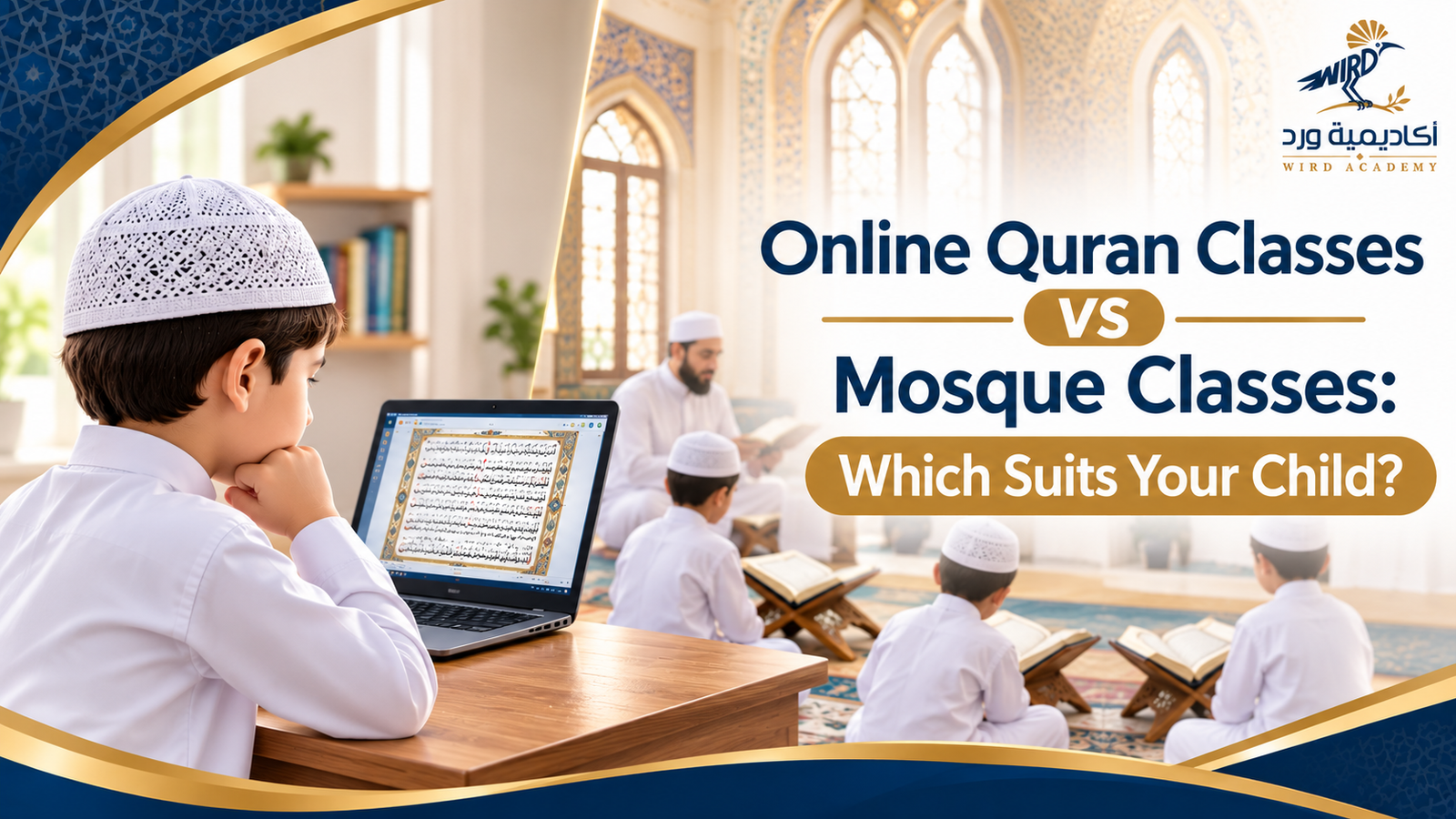
So, when comparing online Quran classes vs mosque classes, which option is actually better?
The answer depends less on where the lesson happens and more on what your child needs from it.
Quick Answer: Are Online Quran Classes Better Than Mosque Classes?
Neither option is automatically better for every child.
One-to-one online Quran classes can offer individual correction, flexible scheduling and learning activities adapted to the child’s level. Local mosque classes may provide face-to-face teaching, friendships, community involvement and regular participation in a shared Islamic environment.
Teaching quality, safeguarding and progress vary between providers.
The best choice depends on your child’s learning needs, confidence, your family’s routine and the quality of the available teaching.
Some children benefit most from one approach. Others can combine both without taking on an excessive workload.
1. Understand What You’re Actually Comparing
Not every mosque class works in the same way, and neither does every online Quran programme.
A local mosque may offer small groups, individual reading turns, experienced teachers and a carefully organised curriculum.
Another may teach larger groups in which students receive less individual attention.
Similarly, online learning may mean a private live lesson, a group session or prerecorded material.
For this comparison, we’ll focus on live one-to-one online lessons versus in-person Quran classes at a local mosque or madrasa.
| What matters | Online one-to-one lessons | Local mosque classes |
|---|---|---|
| Teacher attention | Focused on one learner | Depends on group size and teaching format |
| Learning pace | Can be adjusted individually | May follow a shared class structure |
| Interaction with peers | Usually limited during private lessons | Often a natural part of the experience |
| Travel | No regular journey required | Travel may be necessary |
| Scheduling | Depends on teacher availability | Usually follows an established timetable |
| Parent involvement | May be easier to observe at home | Depends on the mosque’s arrangements |
| Cost | Usually a paid private service | Varies; some offer lower-cost group teaching |
| Safeguarding | Requires clear online supervision policies | Requires clear in-person safeguarding policies |
This table describes common differences, not guarantees about individual providers.
If you’re still deciding how to evaluate a teacher or academy, our UK parent’s guide to choosing online Quran classes covers those broader decisions.
Here, the question is more specific: Which learning environment fits your child best?
2. Does Your Child Need More Individual Reading Time?
Imagine a child who can recognise Arabic letters but regularly confuses similar sounds.
During a group lesson, the teacher may have to divide attention among several children. Your child might receive useful correction, but opportunities to practise aloud depend on the group size and teaching method.
In a private online lesson, the teacher can spend more time listening to that child’s reading and working on the specific difficulty.
That doesn’t make every online teacher more effective than a mosque teacher.
A well-managed small group can also provide valuable individual feedback.
Ask About Actual Reading Opportunities
Before choosing either option, consider:
- How frequently does my child read aloud to the teacher?
- Does someone listen carefully and correct mistakes?
- What happens when the child struggles with a particular skill?
- Can the teacher adapt the work to the learner’s current level?
Don’t judge teaching quality simply by the number of minutes scheduled.
A class lasting an hour does not necessarily provide an hour of individual reading. Equally, a private lesson isn’t automatically productive throughout.
If foundational reading is the main challenge, the Online Quran Recitation programme is one possible option to compare with local teaching.
The real question is whether your child gets enough useful practice and correction to address their learning needs.
3. What Can Mosque Classes Offer That Online Lessons Cannot Easily Replace?
For many Muslim families in Britain, the local mosque is more than a place for Quran lessons.
Children may meet friends, become familiar with the prayer space, learn alongside peers and develop a sense of belonging to the local community.
These experiences matter even when they cannot be measured through reading accuracy or the number of surahs memorised.
A child who enjoys attending the mosque may look forward to their lessons partly because of that social connection.
Online private teaching offers different advantages, but it doesn’t automatically recreate the shared environment of a mosque.
Don’t Treat Community as an Optional Extra
When comparing options, ask what your child would gain or lose socially.
Would leaving the mosque remove an important opportunity to spend time with other Muslim children?
Does your child already participate in other community activities?
Could online support strengthen a particular reading skill while the child continues attending the mosque?
There’s no reason to assume that improved individual reading and community participation must be competing goals.
4. Which Option Fits Your Family’s UK School Routine?
A learning arrangement can look excellent until you try fitting it around school, homework, meals and family commitments.
A mosque five minutes away may be convenient.
Another requiring a long journey on several evenings could become difficult to manage, particularly during winter.
Online lessons remove the journey, but they still require a suitable time, a reliable connection and enough attention for the child to participate.
Compare the Whole Commitment
Consider an illustrative situation.
A family chooses a 45-minute in-person class, but the journey takes 20 minutes each way.
That creates 85 minutes of scheduled class and travel time, excluding preparation.
An online 45-minute lesson removes the journey, although the child still needs time to settle and prepare.
Neither calculation tells you which class teaches better. It simply makes the family’s time commitment clearer.
For parents organising lessons around the school week, How to Build a Quran Learning Routine Around School explores how to create a manageable schedule.
Also check whether online lesson times follow the UK’s seasonal changes between GMT and BST.
Choose a routine your family can maintain, not one that only works during an unusually quiet week.
5. Is One-to-One Teaching Always Better for a Shy Child?
Not necessarily.
Some children feel more comfortable reading privately rather than making mistakes in front of a group.
Others participate more readily when friends are learning alongside them.
A child who is quiet during online lessons may feel isolated by the screen. Another may find an unfamiliar mosque group intimidating.
You cannot reliably predict the better environment from personality labels alone.
Look at the Child’s Response
When possible, observe how your child responds to the actual teaching arrangement.
Notice whether they attempt unfamiliar words, ask for clarification and recover comfortably from mistakes.
Also consider whether the teacher adjusts their approach when the child becomes confused.
A useful starting point is identifying what your child currently knows and which skills need attention. Quran Learning for Kids: What Should They Learn First? explains that decision in more detail.
The goal isn’t to find an environment in which your child never makes mistakes.
It’s to find one where mistakes can be corrected constructively.
6. How Do Safeguarding Arrangements Compare?
Safeguarding matters in both settings, but the practical arrangements differ.
For online lessons, parents should understand the meeting platform, supervision, teacher identity, communication channels and whether sessions are recorded.
For mosque classes, ask about supervision, collection arrangements, safeguarding responsibilities and how concerns are reported.
The UK’s NSPCC guidance on finding a tutor recommends checking suitability, agreeing clear boundaries and ensuring appropriate adult supervision during tutoring.
For online tutoring, it also advises that communication outside sessions should be directed to parents rather than privately to the child.
The advice provides useful safeguarding principles, but it does not mean every UK tutoring requirement applies identically to every provider or location.
Don’t assume a classroom is safe because it is inside a mosque, or that an online lesson is safe simply because it happens inside your home.
Ask each provider how its procedures actually work.
If an important safeguarding concern remains unresolved, convenience or lower fees should not override it.
7. Compare Cost and Value Without Assuming Cheaper Means Better
Families naturally want to know which option is more affordable.
However, comparing a group class fee with the price of individual online teaching can be misleading unless you consider what is included.
A mosque programme may charge a modest fee or operate through donations. Other local providers may have different fees and arrangements.
Private online teaching usually has a clearer per-lesson or per-hour charge.
At Wird Academy, the stated teaching rate is £8 per hour, with options for 30-, 45- and 60-minute paid lessons.
| Lesson duration | Teaching cost |
|---|---|
| 30 minutes | £4 |
| 45 minutes | £6 |
| 60 minutes | £8 |
These are Wird’s stated lesson rates, not typical prices across the UK market.
The academy’s pricing and learning plans explain the available four-week packages.
What Are You Paying For?
Compare the actual teaching time, individual feedback, travel commitments, learning materials and payment conditions.
Ask what happens if your child misses a lesson, and whether rescheduling is possible.
A less expensive group class may provide excellent teaching and community benefits.
A higher-cost individual lesson may be worthwhile when a child needs consistent attention to a particular reading difficulty.
Value depends on what your child receives and needs, not just which fee is lower.
8. Could Your Child Benefit From Both?
Sometimes the most useful decision isn’t online or mosque classes.
It may be to use each for a different purpose.
For example, a child might continue attending a weekend mosque class for community learning while receiving a separate online lesson focused on Arabic reading accuracy.
Another may already have enough guided reading at the mosque and need only manageable home practice.
Adding online lessons in that situation could create unnecessary pressure rather than improve learning.
The Two-Purpose Test
Before combining programmes, answer two questions.
What does the mosque class provide that we want to preserve?
Perhaps it’s community participation, a trusted teacher or a regular group-learning environment.
What specific gap would online lessons address?
For example, targeted pronunciation correction or individual help with reading unfamiliar words.
If you cannot identify a clear learning gap, don’t add more lessons simply because another option exists.
When using two providers, explain the arrangement to both teachers where appropriate, so the child’s learning targets and workload do not conflict.
A combined approach should create clarity, not two unrelated curricula competing for the same limited time.
9. A Practical Decision Guide for UK Parents
After comparing the options, use your family’s actual circumstances to decide.
| Your situation | A sensible next step |
|---|---|
| Your child enjoys the mosque and receives suitable correction | Consider continuing without making unnecessary changes |
| Your child needs more individual pronunciation support | Explore targeted one-to-one teaching |
| Travel makes consistent attendance difficult | Compare online timetables and teaching suitability |
| Your child lacks opportunities to meet Muslim peers | Consider the community value of local mosque activities |
| You’re unsure which method suits your child | Observe a session or arrange an introductory lesson where available |
| Both programmes seem useful but time is limited | Identify one main learning priority before combining them |
There is no universal winner.
A useful final check is to ask whether the chosen arrangement provides three things:
Appropriate teaching, a manageable routine and a learning environment where your child feels supported.
If one of these is missing, clarify the problem before committing.
For families considering online teaching, What Happens in a Child’s First Online Quran Lesson? explains what to observe during an introductory session.
Frequently Asked Questions
Not automatically. Private online lessons can provide individual correction and scheduling flexibility, while mosque classes may offer valuable in-person learning and community. Teaching quality and suitability matter more than the format alone.
Yes, live online teaching can support pronunciation demonstrations, listening and correction. Effectiveness depends on the teacher’s competence, audio quality, learner participation and suitable practice.
Group-based mosque classes may cost less, but fees vary. Compare the teaching format, duration, supervision, learning support and payment terms rather than price alone.
It can be if the combined workload is excessive. Define a separate purpose for each programme, consider school commitments and review whether your child is coping comfortably.
Ask about qualifications, experience with children, teaching methods, correction, safeguarding and progress reviews. An introductory lesson or opportunity to observe teaching can help you make a more informed decision.
Choose the Learning Environment That Meets Your Child’s Needs
If one-to-one lessons at home suit your family, our Quran classes for children in the UK run after school and at weekends, and parents are welcome to sit in on any lesson.
The choice between online Quran classes and mosque classes isn’t about proving that one method is superior.
It’s about understanding what your child needs, what your local options provide and which arrangement your family can sustain.
For some children, the mosque is the right place to continue learning. Others may benefit from more individual support, while some families find that the two approaches complement each other.
At Wird Academy, families can request a short introductory lesson to meet a teacher, explore their child’s starting level and receive initial feedback before deciding whether online learning is suitable.
If you’d like to assess that option without committing to a paid plan, you can request a free trial lesson.
Submitting a trial request does not automatically confirm an appointment or enrol your child in a paid programme.
